- Overview
- UXO Detection
- Tunnel Detection
- Motion Detection
GSSI at the Forefront of Protection Technology
Military, security personnel and border patrols use ground penetrating radar in various configurations to detect unexploded ordnance, to locate the presence of tunnels or detect movement near exterior walls or in buildings. This technology is key to helping protect borders and aid military operations in helping secure areas.
Locate UXOs Using Ground Penetrating Radar
Military personnel use ground penetrating radar to locate UXOs in the ground. Note that this technology is best suited for detecting metallic targets and may not be suited for detection of certain types of mines.
Two 155 mm rounds that have become lodged beneath the road surface. The target on the left is parallel to the direction of travel of the antenna and the target on the right is perpendicular. Data collected with a SIR-20 and a 1 GHz horn antenna.
|
|
Locate and Trace Tunnels using Ground Penetrating Radar
Border patrol, security and law enforcement professionals use ground penetrating radar to locate and trace tunnels concealed in secure areas. Depending on soil conditions and tunnel diameter, GPR will detect the depth and path of tunnels buried deep below the surface.
Hand-dug tunnel in close proximity of a large pipe located along the southern US border. Data collected with a SIR-3000 and a 200 MHz antenna.
|
|
|
UltraSensor - Detect Surface Movement and Through-Wall Motion
Using ultra wideband technology, the UltraSensor is designed to be buried underground, in building sidewalls or located above ceilings. UltraSensor reports not only movement but also direction, velocity, and amplitude. UltraSensor is the security industry’s first truly practical and effective perimeter motion sensor offering high perimeter security with extremely low false alarms.
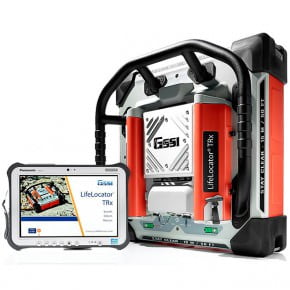
LifeLocator - Sensing Life In Motion
LifeLocator III® (pictured, right) is designed and engineered to find living victims of a catastrophic building collapse, mudslide or avalanche. The wireless system is capable of searching through debris to find living victims up to 20 feet (6 meters) below the surface. LifeLocator III means rescue, not recovery.
|
|
|