Providing the Most Accurate Road Data in the Industry
Highway professionals, engineers and transportation departments require a safe, reliable and non-destructive method to evaluate roads for pavement preservation, planning and rehabilitation. Ground penetrating radar offers users a quick and effective way to determine pavement layer thickness. GPR can evaluate base and sub-base layers with data collection densities not obtainable by traditional labor-intensive methods, such as coring.
Ground Penetrating Radar Measures Pavement Thickness at Highway Speeds
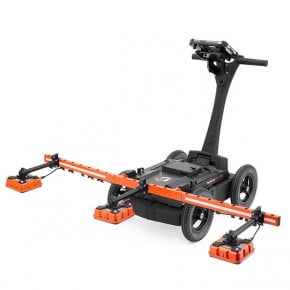
GSSI’s RoadScan system uses air-launched horn antennas, providing a method for data collection at highway speeds and eliminating the need for lane closures. It is now possible for transportation professionals to collect hundreds of miles of pavement layer thickness data in just one day.
Data (top) illustrates a 2D line scan of GPR ready for FWD integration. Data dropped in Google Earth™ (bottom).
|
|
Ground Penetrating Radar and FWD Working Together
GSSI remains the leader in meeting the needs of transportation professionals by collaborating with leading FWD companies such as JILS and Dynatest.
Data illustrates a 2D line scan of GPR data ready for FWD integration.
|
Please
visit JILS for more information on JILS fully integrated FWD/GPR products.
Please
visit Dynatest for more information on Dynatest FWD products.
|
Use GPR for Base and Sub Base Evaluations of Roadways
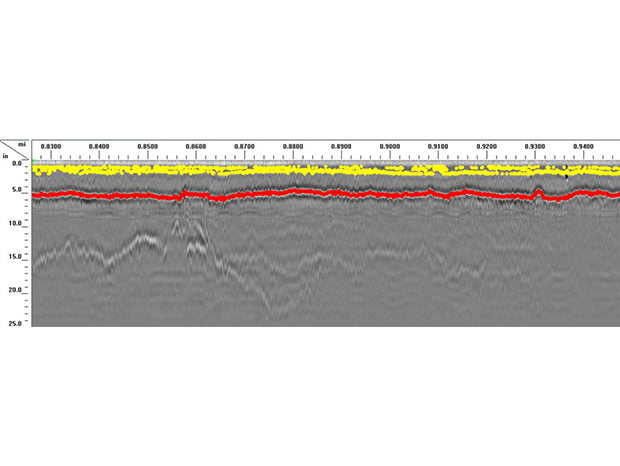
GPR provides engineers and transportation departments with an effective tool for evaluating base and sub-base layers with data collection densities not obtainable by other labor-intensive methods, such as coring.
Data illustrates a 2D line scan identifying layers in RADAN’s Interactive Interpretation mode.
|
|
Locate Voids in Roadways with Ground Penetrating Radar
Construction professionals, engineers and transportation departments can identify and delineate voids under the surface with ground penetrating radar (GPR).
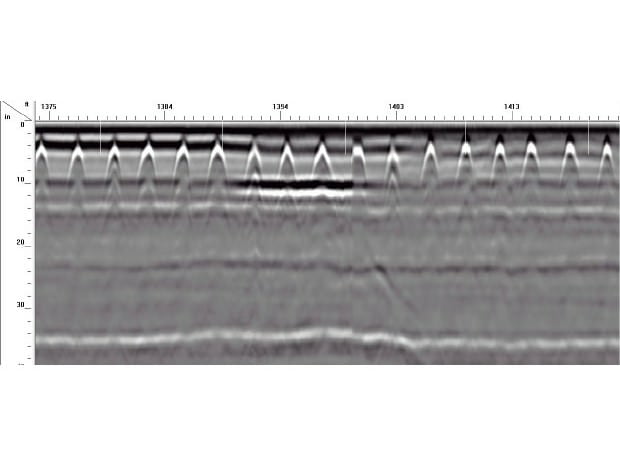
The data represents a large void beneath a concrete roadway. Note the slumping rebar above the void. Data collected with a SIR-3000 and a 900 MHz antenna.
|
|