What is EM?

The electromagnetic (EM) induction method is based on the measurement of the change in mutual impedance between a pair of coils on or above the earth’s surface. Most EM instruments are comprised of two or more sets of coils. These coils are electrically connected and are separated by a fixed distance. The transmitter coil is used to generate an electromagnetic field at a specific frequency. This is known as the primary field. The primary field causes electrical currents to flow in conductive materials in the subsurface. The flow of currents in the subsurface, called eddy currents, generate a secondary magnetic field, which is sensed by the receiver coil. The magnitude of the secondary field sensed by the receiver depends upon the type and distribution of conductive material in the subsurface. Both the induced secondary field, along with the primary field, are detected at the receiver coil.

The magnitude of the secondary field is broken into two orthogonal components. These are the In-phase (real component) and the Quadrature component (imaginary component). Under certain operating conditions, the magnitude of the Quadrature component of the secondary field is linearly proportional to the apparent conductivity. In the absence of a highly conductive material (e.g., metal or metallic targets) in the subsurface, the magnitude of the in-phase component is dependent on the magnetic susceptibility of the subsurface.

Electromagnetic (EM) Locator technology relies upon the detection of an alternating magnetic field. This magnetic field is created by the flow of current through a conductor, whether a wire, cable, pipe, or other conductive material. Often, additional ‘tracer wires’ are run in parallel to non-conductive pipes such as gas lines expressively for the purpose of facilitation such detection. AC power utilities, as long as current is flowing in the form of power usage, usually radiate a very detectable magnetic field as a side-effect of normal operation. It is also possible to intentionally induce a ‘tracer’ current (by inductive clamp or direct attachment) onto otherwise passive conductors in order to create a detectable field that can be followed.
LineTrac technology is a multi-sensor fashion technology that combines the power and advantage of GPR with the specific target-identifying capabilities of EM location. Linetrac operates in both “Power” (50 or 60 HZ Utility Power) and in arbitrary “Frequency Mode” up to 50KHz, using a customer-supplied transmitter.
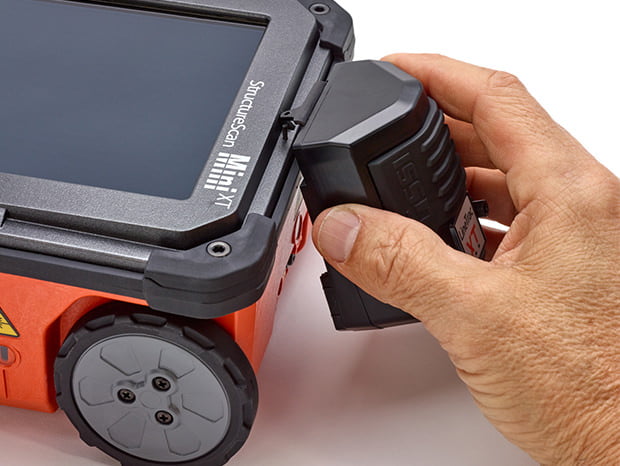
GSSI manufactures two models of EM locator technology. Above is our LineTrac system for our UtilityScan series, to the left is our LineTrac XT for our StructureScan Mini XT system.